
Two of the most popular exotics in Texas, but they serve different purposes. Here's a head-to-head comparison to help you decide which species — or combination — makes the most sense for your operation.
Ask any Texas ranch owner which exotic they'd recommend first, and the answer is almost always Axis deer or Fallow deer. Both species are well-established in Texas, breed reliably, and offer strong hunting and breeding value. But they're not interchangeable — each has distinct characteristics that make them better suited to different ranch types, goals, and environments.
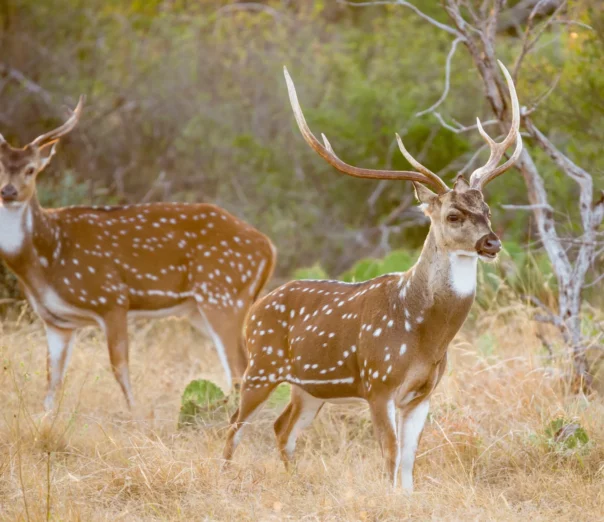
Axis Deer: The Texas Standard
Axis deer (Cervus axis) are native to the Indian subcontinent and were introduced to Texas in the 1930s. Today, the Texas Hill Country hosts the largest free-ranging Axis population outside of India. They're the most hunted exotic in the state for good reason.
Why ranchers love Axis:
- —Year-round breeding — does can cycle multiple times per year, meaning fawns on the ground in every season
- —Exceptional venison — widely considered the best-tasting wild game in North America
- —Trophy value — mature bucks with 30"+ main beams command $1,500–$4,000+ hunt fees
- —Adaptability — thrives in Hill Country, South Texas, and East Texas environments
- —Strong auction market — consistently among the highest-demand species at Texas exotic sales
The main challenge with Axis is their energy. They're athletic, can clear standard livestock fencing, and require proper high-fence containment. They're also competitive with native whitetail for browse and water, which can be a management consideration on properties where you're running both species.
Fallow Deer: The Versatile Choice
Fallow deer (Dama dama) are native to the Mediterranean region and are one of the oldest domesticated deer species in the world. They come in four distinct color phases — common (tan with white spots), menil (lighter with more defined spots), black, and white — which makes them visually striking and popular with hunting operations that want variety and aesthetics.
Why ranchers love Fallow:
- —Four color phases add visual diversity and appeal for hunting guests and ranch tours
- —Browsers rather than grazers — less competition with native grasses and livestock
- —Smaller body size means lower carrying capacity impact per animal
- —Palmated antlers are unique and highly recognizable as trophies
- —Generally calmer temperament than Axis — easier to manage and work
Color phase matters at auction. White Fallow and Black Fallow consistently bring premium prices over common phase animals. If you're building a breeding program, prioritize color phase diversity in your foundation does.
Head-to-Head Comparison
Here's how the two species stack up across the factors that matter most to Texas ranch operators:
- —Hunting demand: Axis (High) vs. Fallow (Medium-High)
- —Breeding productivity: Axis (Very High — year-round) vs. Fallow (High — seasonal)
- —Venison quality: Axis (Exceptional) vs. Fallow (Very Good)
- —Property impact: Axis (Higher browse pressure) vs. Fallow (Lower — browsers)
- —Fence requirements: Both require 8-foot high fence minimum
- —Auction value: Axis (Consistently strong) vs. Fallow (Strong, especially color phases)
- —Temperament: Axis (More reactive) vs. Fallow (Calmer, easier to work)
The Answer: Run Both
Most successful Texas exotic operations run both species. Axis provide the hunting revenue backbone and year-round activity, while Fallow add visual diversity, lower browse pressure, and a different hunting experience. A 500-acre property might carry 40 Axis and 25 Fallow comfortably, giving you a full hunting menu and a diverse breeding program.
The key is starting with quality foundation stock. Both species are available at the Huntsville Exotic Sales, where you can inspect animals in person and buy from established Texas breeding programs with documented health histories.
Tags